
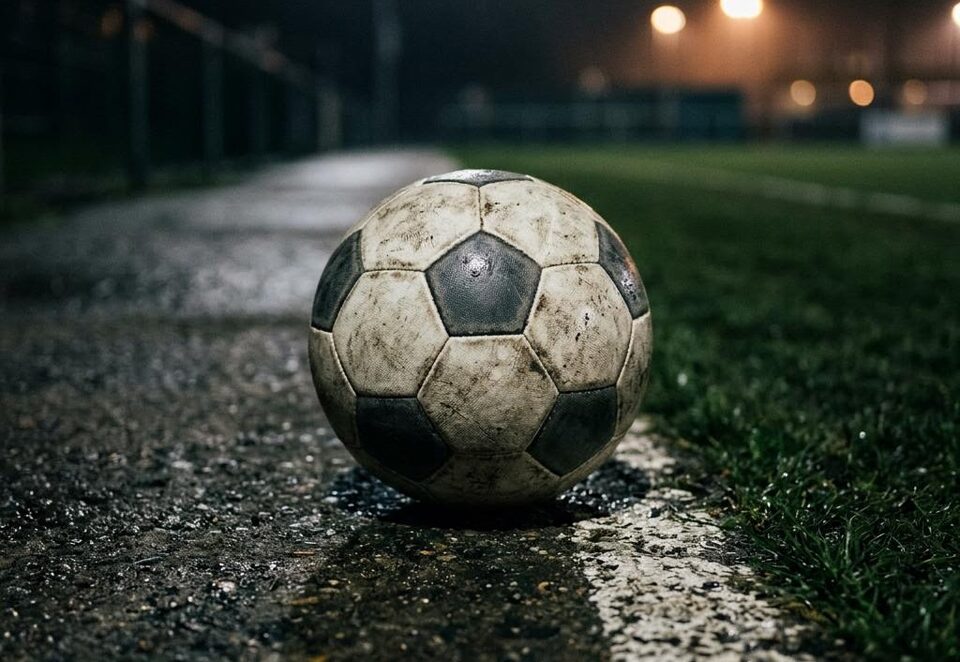
Start with the ground under your player's feet. An everyday ball should suit the place it gets most of its touches—not just the surface in its product photo.
01 / On natural grass, start with an outdoor training ball
For regular sessions on a grass field, look for an outdoor soccer ball sold for training or club practice. A training label describes intended use, not an official quality grade or a promise that every ball lasts the same number of sessions. If the team supplies match balls, a separate premium match ball is not automatically useful for home practice.
Check the specific ball's size against your player's competition and feel it at the manufacturer's recommended pressure. On wet grass, panel seams and construction can affect water uptake: bonded designs may take up less water than stitched designs, but construction alone does not prove one model will feel or last better for your family.
02 / Artificial grass: check the model's stated use
A synthetic full-size pitch is not the same thing as a hard indoor court. Some makers sell balls explicitly intended for artificial grass and list match or training use for that surface. If most sessions happen on a synthetic field, check the particular ball's surface designation rather than assuming every outdoor ball, or every ball labeled “turf,” is built for the same conditions.
If practices alternate between natural and artificial grass, read the manufacturer's permitted surfaces for the exact model and ask the coach or facility about any equipment rules. Inspect the cover and seams after repeated sessions; do not infer guaranteed abrasion resistance from a panel count, a surface label or a high price.
03 / Indoor soccer and futsal are different questions
Before buying for a gym or indoor venue, find out what game is being played and what ball the facility allows. A hard-court indoor game may call for an indoor ball; a boarded indoor venue may have its own rules. An outdoor ball should not be assumed acceptable just because its size looks right.
Futsal has its own ball specifications, including a controlled, lower rebound than a standard outdoor soccer ball. The FA's published futsal Law 2 sets a rebound range as well as circumference and pressure requirements. Do not substitute an ordinary size 4 outdoor ball simply because a futsal ball looks similar in diameter. Ask the organizer about youth modifications and whether it supplies the ball.
04 / Read the construction without treating it as a ranking
The cover, inner layers, bladder and panel joins all affect a ball's design. Panels may be machine-stitched, hand-stitched, bonded or made with a combination of seams and bonding. SELECT describes bonded seams as reducing water uptake on wet fields; that does not make bonding a universal measure of quality or durability.
Compare a few balls intended for the same surface and session. Check the printed surface guidance, shape, visible seams, the player's touch and the price you would be comfortable paying again. No untested model here is being rated or recommended over another.
05 / Keep the choice useful after checkout
Use the pressure range printed on the ball or in its maker's instructions—not a single pressure borrowed from adult match rules. Check pressure before play, use an appropriate pump needle as directed by the maker, and clean and dry the ball according to its care instructions. Repeated use on concrete or asphalt can scuff a field ball faster; look for a ball designated for that surface if that is where the family actually plays.
Before paying, answer four questions: Where will it be used most? Is that surface listed for this exact model? Does the coach or facility require a different type of ball? Is the selected size the one your competition uses? For league-specific sizes, use the separate ball-size guide rather than an age label on a shelf.
Choose for the usual surface first, check the exact ball's stated use and pressure, and confirm indoor or futsal rules with the organizer. A training label is a starting point, not a tested durability claim.
Sources and further reading
Manufacturer descriptions explain intended use and construction, not independent test results. Check your ball's current instructions and your venue's rules.