
Indoor soccer doesn't automatically mean wearing the same cleats you use outside.
Indoor facilities can use different surfaces, from hard court-style floors to turf-like fields. The right footwear depends on what is underneath the player and what the facility allows.
Before buying a pair of indoor soccer shoes, find out what surface the facility uses and what footwear it permits.
Quick answer
Indoor soccer shoes
- Typically for
- Hard indoor courts and gym-style floors
- Underfoot
- Flat, non-marking rubber
Turf shoes
- Typically for
- Short, firm synthetic turf
- Underfoot
- Many small rubber nubs
Outdoor cleats
- Typically for
- Natural grass or specific outdoor synthetic fields
- Underfoot
- Studded for the intended surface
Always check the facility's footwear rules because indoor surfaces and policies can vary.
Find Out What “Indoor” Means
An indoor facility could have a hard court, sport-court tiles, a gym-style floor or a turf-like field. The word “indoor” describes the building, not the floor beneath your player's feet.
Start by asking the venue these two questions before choosing a shoe.
What Are Indoor Soccer Shoes?
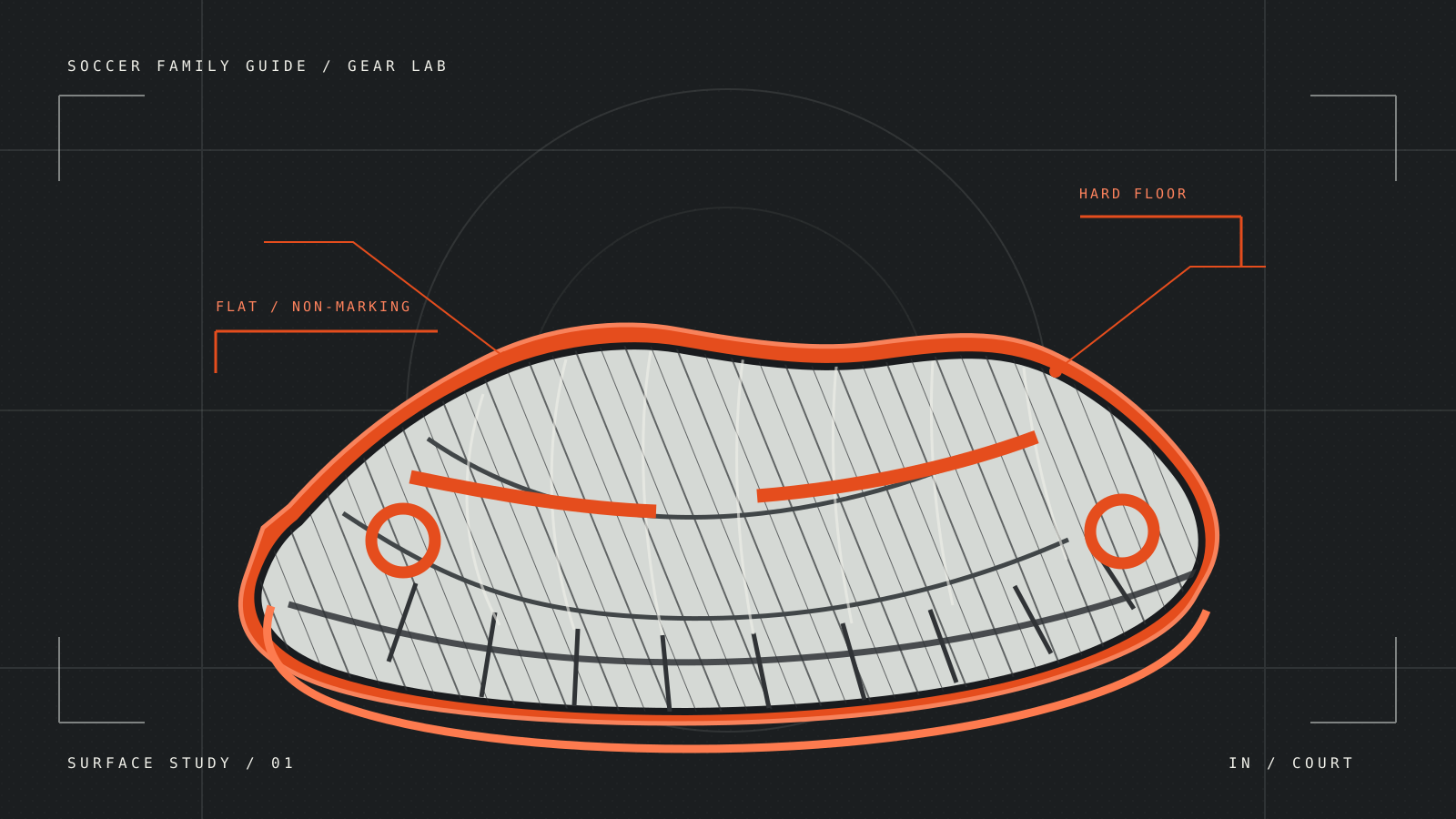
Indoor soccer shoes generally have flat, non-marking rubber outsoles designed for hard indoor playing surfaces. Unlike outdoor cleats, they do not have molded studs beneath the sole.
They may be labeled “IN” or simply “indoor.” The label is a starting point; the fit and the surface underfoot still matter.
Indoor Shoes vs Turf Shoes
Indoor shoes and turf shoes are not the same thing. A flat court outsole is made for hard floors; the many small rubber nubs of a turf shoe are generally meant for short, firm synthetic turf.
A turf shoe is not simply an indoor shoe with more traction. If the indoor venue has turf, use the turf-shoe category as a starting point rather than judging by the building's name.
Indoor soccer shoes
- Outsole
- Flat, non-marking rubber
- Surface
- Hard indoor or court-style floor
Turf shoes
- Outsole
- Small rubber nubs
- Surface
- Short, firm synthetic turf
Can You Wear Outdoor Cleats Indoors?
Usually, you should not assume outdoor cleats are permitted indoors. A hard court may require flat soles and some facilities prohibit studs. An indoor turf venue may have different rules.
Outdoor cleats are not a universal indoor option. Check the facility's footwear policy before bringing the pair used for outdoor games.
How Should Indoor Soccer Shoes Fit?
The heel should feel secure, the toes should have comfortable room and the forefoot should not pinch. The foot should not slide excessively inside the shoe when the player stops or changes direction.
Try both shoes with playing socks and let the player move naturally on a clean indoor floor if the retailer's return policy permits. There is no single toe-space measurement that fits every player.
Player View / Parent View
Player view
What does the shoe feel like?
- Comfort
- Fit
- Movement
- Touch
- Flexibility
- Confidence
Parent view
Does it make sense for the indoor schedule?
- Facility rules
- Frequency
- Price
- Durability
- Growth
- Return policy
The right indoor shoe should fit the player and the facility.
One Pair or Two?
Can one pair do everything? It depends on the surfaces in the player's actual schedule and what each venue permits. Use the situations below to decide whether a second pair would get enough use.
A regular court schedule
A dedicated indoor pair may make sense when hard floors are where the player spends most of their time.
Indoor + outdoor
Separate footwear may make sense if both surfaces appear regularly and call for different outsoles.
An occasional session
A second pair may not be necessary. First find out what the venue permits.
Before You Buy
- I know what surface the indoor facility uses.
- I know what footwear the facility allows.
- I know whether the shoe has a non-marking outsole.
- The shoe fits comfortably.
- The player can move naturally in it.
- I understand the return policy.
- The player will use the shoes often enough to justify the purchase.
Common Indoor Footwear Mistakes
- 01
Assuming every indoor field is the same
A hard court and a turf-like indoor field call for different questions.
- 02
Bringing outdoor cleats without asking
Studs may not be permitted, especially on hard floors.
- 03
Confusing turf with court shoes
Small rubber nubs are different from a flat court outsole.
- 04
Buying the look instead of the fit
A good colorway cannot fix a slipping heel or painful pressure.
- 05
Overlooking the footwear policy
The venue decides which outsole types can be worn there.
The bottom line
Indoor soccer shoes are generally designed for hard indoor surfaces, while turf shoes are designed for short synthetic turf and outdoor cleats are designed around specific outdoor surfaces.
Start with the floor or turf underneath the player, check the facility rules, then choose footwear that fits comfortably and matches the player's actual schedule.